
Introduction
A night light can make a child's bedroom feel more reassuring after dark, but brighter and more colorful does not necessarily mean better. When choosing sensory lights for kids, look for adjustable brightness, comfortable colors, simple controls, and a design that can shift from interactive play to a quieter bedtime setting.
That distinction matters because children can respond very differently to light. Some may prefer a very dim, steady glow, while others feel more comfortable with a little more illumination or a particular color. A sensory night light should therefore be adjustable enough to match the child’s comfort level without making the bedroom unnecessarily bright.
Quick Answer: What Should You Look for in a Sensory Night Light?
A good sensory night light should be dimmable, easy to control, and flexible enough to match your child's individual sensory preferences. For bedtime, favor low-intensity, warmer light and avoid bright, blue-heavy settings close to the bed.
If a child needs a night light for reassurance, use only as much light as necessary rather than trying to illuminate the entire bedroom.
What Makes a Night Light "Sensory"?
A conventional kids night light has a fairly simple job: provide enough illumination to make darkness feel less intimidating or help someone navigate the room.
Sensory lighting adds another dimension. It gives the child or caregiver more control over the experience through features such as adjustable colors, brightness levels, touch interaction, patterns, or customizable arrangements.
That flexibility matters because there is no single color or lighting effect that every child finds calming. Some children enjoy gentle interaction with light before bed, while others settle more easily when the room becomes visually simple and predictable.
For more ways to think about lighting as part of the whole environment, explore our sensory room lighting ideas.
What Color Night Light Is Best for Kids?
For the period immediately before sleep, warm colors are generally a better starting point than bright, cool light.
Research on sleep and circadian rhythms shows that light's effects depend on several factors, including its spectrum, intensity, timing, and duration. Blue-rich light is particularly effective at signaling daytime and promoting alertness, while warmer red, amber, yellow, and orange tones tend to have less circadian impact when kept dim.
That does not mean every child's bedroom needs to glow red. Personal comfort still matters. The practical takeaway is simpler: save brighter or cooler colors for play and daytime activities, then transition toward a dimmer, warmer setting as bedtime approaches.
If you want a deeper look at this relationship, our guide to color temperature in youth room lighting explains how color temperature changes the feel and function of a child's space.
How Bright Should a Kids Night Light Be?
Dimmer is generally better once it is actually time to sleep.
Dimmer is generally a better starting point once it is actually time to sleep, but there is no single brightness level that works for every child.
Instead of looking for the brightest option, ask a more useful question: What does my child actually need the light to do?
If it is there mainly because they feel uncomfortable in complete darkness, a faint glow may be enough. If the same light is also used for reading, getting dressed, or play, choose a brighter setting for those activities and lower it as the bedtime routine begins. The goal is to provide enough light for comfort and orientation without filling the whole room with unnecessary brightness.
Instead of searching for the brightest lamp, ask a more useful question: What does my child actually need the light to do?
If it is there simply because they dislike complete darkness, a faint glow may be enough. If it is also used for reading, getting dressed, or play, use a brighter setting for those activities and reduce it when the bedtime routine begins.
Where Should You Place a Sensory Night Light?
Placement changes how much light reaches your child's eyes, so it deserves as much attention as color and brightness.
Rather than placing a bright source beside the child's face, consider positioning the light where it creates a softer glow across the room. Depending on the product and bedroom layout, that could mean a nearby wall, a lower surface, or another location that provides orientation without becoming the visual focus of the bed.
The goal is not to make the bedroom look impressive at midnight. It is to provide enough comfort while preserving the contrast between day and night.
Can Sensory Lights Help Kids Calm Down Before Bed?
They can be part of a calming routine, but it is important not to overstate what lighting can do.
A predictable change in the room—such as moving from brighter activity lighting to a softer evening setting—can become a useful environmental cue that playtime is ending. Consistent bedtime routines and progressively dimmer evening lighting are widely recommended as part of healthy sleep habits for children.
A sensory light should therefore be viewed as a supportive environmental tool, not as a treatment for sleep difficulties, anxiety, ADHD, autism, or sensory processing conditions.
Parents looking specifically at neurodivergent spaces can also read our guide to sensory lights for autism for additional room-design considerations.

Should Sensory Lights Be Interactive at Bedtime?
Interactive lighting can be valuable during the day because it gives children agency over their environment. Touching a panel, selecting a color, or building a pattern turns light into something they can explore rather than simply observe.
Bedtime is different.
Fast-changing colors, flashing effects, or repeated interaction can keep the experience stimulating when the goal is to reduce stimulation. A useful approach is to separate the two modes: let the lighting be playful earlier, then choose one dim, stable setting for the bedtime routine.
This is one reason adjustable products can make more sense than a night light with only one fixed behavior.
How Do You Choose Sensory Lights for Kids With Different Preferences?
Start with the child rather than the trend.
Some children prefer almost complete darkness. Others feel more comfortable with a small amount of light. One child may enjoy a soft amber glow while another prefers a different low-intensity color.
Look for features that give you room to experiment:
- Adjustable brightness rather than one fixed output
- Multiple color options
- A stable mode without mandatory animation
- Simple controls that a child can understand
- Placement options that keep the source away from the face
- A timer or easy shutoff where appropriate
Then observe how your child responds. If they repeatedly ask for less light, move the source farther away or reduce the brightness. If they are still uncomfortable in the dark, forcing complete darkness simply because it is theoretically optimal may make bedtime harder. Sleep guidance acknowledges that a small, dim night light can be reasonable when a child is afraid of the dark.
How Can Lighting Change From Playtime to Bedtime?
The most useful children's lighting does not have to perform the same job all day.
During play or creative time, colorful interactive light can add personality and encourage exploration. Later, the same room can become visually quieter by reducing brightness, movement, and color complexity.
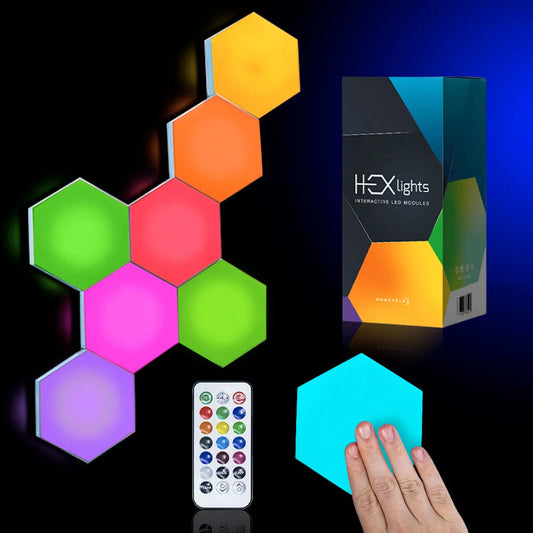
For example, HEXlights Touch Pix Boys and HEXlights Touch Pix Girls offer a more playful way to personalize a child's lighting environment, while HEXlights Kids 7-Pack provides modular lighting that can be arranged into different designs. Emberela describes its children's HEXlights as touch-interactive, customizable, and adjustable across multiple colors and brightness levels.
That versatility reflects the broader approach behind Emberela Products: lighting can be interactive when a child wants engagement and quieter when the room needs to settle.
Human Insight: The "Best" Night Light May Change During the Evening
Parents often shop for a single perfect bedtime setting, but a child's room rarely has only one lighting need.
At 6:30 p.m., the room might be used for building, drawing, or getting ready for tomorrow. At 7:30, it may become a reading space. Twenty minutes later, the child may only need enough light to feel comfortable falling asleep.
Thinking in transitions rather than one setting makes sensory lighting much more practical.
Use brighter, engaging light when the child is active. Soften it as the evening progresses. Once it is time to sleep, reduce the room to the lowest comfortable level—or darkness if your child is comfortable with it.
That creates a bedroom that responds to the child instead of expecting the child to adapt to one fixed lighting environment.
What Mistakes Should Parents Avoid With Kids Night Lights?
One common mistake is treating color as the only factor. A warm light can still be disruptive if it is extremely bright, while a carefully positioned low-intensity light may create far less exposure.
Another is assuming that "sensory" automatically means constantly moving, flashing, or changing colors. Sensory comfort can also come from predictability and control.
Finally, avoid making medical promises based on lighting. A product may help create a more comfortable environment, but claims that a particular color will treat anxiety, improve ADHD symptoms, or regulate a child's nervous system go beyond what the evidence supports.
A Simple Night-Light Checklist for Parents
Before choosing a sensory night light, ask:
Can I dim it?
Brightness control gives you more flexibility as bedtime approaches.
Can I choose a stable color?
A fixed low-intensity mode is useful when animated effects are no longer appropriate.
Can I position it away from the bed?
Distance and placement affect how much light reaches the child's eyes.
Can my child use it easily?
Simple controls can give older children some independence without making bedtime complicated.
Can it work beyond bedtime?
A flexible sensory light can serve as creative décor or interactive lighting during the day instead of becoming a single-purpose object.